Skip to content

Open Clinical Intelligence Lab

Open Infrastructure for Clinical Intelligence

Accelerating clinical coding, healthcare knowledge systems and evidence generation through open science and AI-assisted research.

Open-Source Principles
Reproducible by Design
Privacy & Ethics First
Open Science & Transparent

About OCIL

An open research lab for clinical knowledge infrastructure

OCIL is an independent, open research lab founded by alumni of the University of Cambridge PACE Data Science, Machine Learning & AI programme. It started as our capstone project for NICE: a multi-agent system for clinical code discovery, now live at clinicalcodes.uk. We've kept building since — developing open methods, tools and datasets, and releasing them so the wider healthcare community can build on our work.

Focus Areas

  • Clinical AI
  • Health Data Science
  • Clinical Informatics
  • Clinical Coding Systems
  • Healthcare Knowledge Engineering
  • Reproducible Research Infrastructure
  • Evidence Generation
  • Open Science
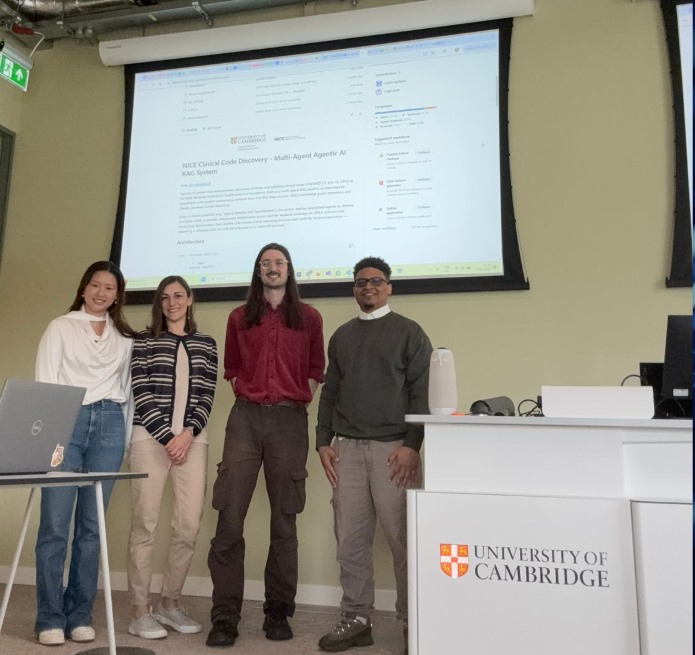
OCIL founding team presenting at the University of Cambridge
Founding team · University of Cambridge

Projects

Open infrastructure projects

What we build and keep maintained in the open.

Active

NICE Clinical Code Discovery

A LangGraph multi-agent pipeline that discovers and validates clinical codes across UK vocabularies (SNOMED CT, ICD-10, OPCS-4, dm+d, BNF). Six parallel retrievers, UMLS enrichment and per-code LLM scoring return a provenance-tracked codelist in seconds, behind an audited human-in-the-loop review gate. Built with NICE and the University of Cambridge.

  • Clinical Coding
  • LangGraph
  • SNOMED CT / ICD-10
  • UMLS
  • Human-in-the-loop
  • NICE
Research prototype

Inquest

An agentic pipeline for clinical-trial safety analysis. Inquest retrieves evidence from seven public sources, generates competing failure-mechanism hypotheses constrained to a published safety taxonomy, adversarially verifies every claim against cited evidence, and synthesises a calibrated, fully provenance-tracked triage memo for expert review.

  • Clinical Trials
  • Drug Safety
  • Evidence Verification
  • LangGraph
  • Provenance

Research

Research areas

The areas we work across, from clinical AI down to the open infrastructure underneath it.

Clinical AI

Where language models and ML actually help in the clinic: coding, retrieval and reasoning, built to be safe enough for real use.

Clinical Informatics

The terminologies and ontologies that connect messy clinical data to how care is recorded in practice.

Health Data Science

Careful, reproducible analysis of the routine data the health system already collects.

Knowledge Engineering

Turning vocabularies, guidelines and literature into a graph you can actually query.

Evidence Generation

Methods for finding and checking clinical evidence, with the working shown.

Open Science Infrastructure

The shared tools and datasets that let other people reproduce what we do.

Publications

Working papers & reports

Open, citation-friendly outputs from the lab. Search by title, author or abstract.

  1. OCIL Working Paper · with NICE2026Working paper · in preparation

    A Reproducible Multi-Agent Framework for AI-Assisted Clinical Code Discovery

    C. J. Ramirez, A. Desalvo, D. Cage, A. Ramsawhook, Z. Li, I. Thanigaivelan

    We present a LangGraph multi-agent pipeline that discovers and validates clinical codes across UK vocabularies (SNOMED CT, ICD-10, OPCS-4, dm+d and BNF). Six retrievers run in parallel over 53,000+ ingested codes, with UMLS synonym and hierarchy enrichment and per-code LLM scoring behind an audited human-in-the-loop review gate. Against 15 published OpenCodelists reference standards, mean F1 improved from 0.49 to 0.57 (p = 5.7×10⁻¹¹), with per-code rationale faithfulness of 83.5%.

  2. OCIL Research Prototype2026Research prototype

    Inquest: Adversarially-Verified Failure-Mechanism Triage for Terminated Clinical Trials

    C. J. Ramirez

    Inquest is an agentic pipeline that analyses terminated clinical trials. It retrieves evidence from seven public sources, generates competing failure-mechanism hypotheses constrained to a published safety taxonomy, and subjects each atomic claim to adversarial verification against cited evidence before deterministic scorecard synthesis. On six verified terminated trials it achieved 5/6 top-1 mechanism matches with full citation traceability (1.00) and calibrated confidence.

Community

An open ecosystem

The people and institutions we build alongside, and the communities we want to work with.

Who we work with

  • Universities
  • Healthcare organisations
  • Open-source contributors
  • Research communities
  • NHS stakeholders
  • NICE stakeholders
  • HDR UK community
  • Research engineers
  • PhD students

Ecosystem & aspirational collaborators

  • University of Cambridge
  • University of Oxford
  • UCL
  • Imperial College London
  • NICE
  • NHS
  • HDR UK
  • OpenSAFELY
  • GitHub
  • PyPI
  • Hugging Face
  • Open Knowledge communities

These represent ecosystem and community categories and aspirational collaborators. They are not confirmed partnerships or endorsements unless explicitly stated.

Team

Researchers & engineers

The people behind OCIL, working across clinical AI, data science and informatics.

Carlos J. Ramirez

Carlos J. Ramirez

Founder & Research Engineer

Research interests

  • Applied AI & MLOps
  • Multi-agent systems
  • Clinical coding systems
  • Health data science
  • Open infrastructure
No listed publications
Anna Desalvo

Anna Desalvo

Life Sciences Data Scientist

Research interests

  • Early drug discovery
  • Biomedical engineering
  • Machine learning
  • Phenotypic screening
  • Cancer immunology
No listed publications
Dominic Cage

Dominic Cage

Biomedical Data Scientist

Research interests

  • Biomedical data science
  • Immunology & oncology
  • Toxicology
  • Clinical code retrieval
  • Ontologies
No listed publications
Ashley Ramsawhook

Ashley Ramsawhook

Data Science & Machine Learning

Research interests

  • Functional genomics
  • AI/ML for drug discovery
  • Disease modelling
  • Stem cell biology
  • CRISPR
4 publications

Contact

Work with us

We collaborate with universities, healthcare organisations and open-source communities. Tell us about your project.

Location
Cambridge / London, United Kingdom